Short answer: five tools cover about eighty per cent of what a home mechanic actually does, and they come to roughly ₹5,000 together: a good set of hex keys, a floor pump, a chain wear indicator, a chain tool and a torque wrench. Buy those first and buy them once. Everything after that depends on whether you want to service your own drivetrain, and a repair stand is the last thing to buy rather than the first.
- Buy in this order
- The first five
- Or buy a kit instead
- The drivetrain tools
- The repair stand question
- Tools not to buy
- FAQs
- Narrowing it down
Buy in this order
The usual mistake is buying a large kit on day one, using six pieces from it, and discovering the six you use are the cheapest ones in the box. The better approach is to buy tools in the order you will actually need them, and to spend properly on the ones you will touch every week.
A rough guide to what each tier costs and unlocks:
| Tier | Spend | What it lets you do |
|---|---|---|
| The first five | About ₹5,000 | Adjust everything, inflate properly, catch a worn chain |
| Drivetrain tools | About ₹4,000 more | Replace chains and cassettes yourself |
| A repair stand | ₹14,000 to ₹35,000 | Makes everything above easier, nothing new possible |
| Bearing and facing tools | ₹10,000 and up | Jobs you should probably not be doing |
The first five

1. Hex keys, and do not economise here
Nearly every bolt on a modern bike takes a 4mm, 5mm or 6mm hex. Cheap keys are made of soft steel, they round off inside the bolt head, and then you have a much bigger problem than the one you started with.
The IceToolz 70Ta T-type set at ₹990 covers the three sizes you use constantly, and the T-handle gives you far better control than a folding multitool. The IceToolz 36Q1 ball-ended set at ₹690 is the cheaper L-shaped option. If you want to buy once, the Birzman T-bar set at ₹8,890 is a lifetime purchase.
Add a Torx set at ₹2,275 if your bike has disc brakes, because rotor bolts and many brake fittings are T25.
2. A floor pump
A track pump with a real gauge is the tool you will use most often, and a hand pump is not a substitute. Correct pressure does more for how a bike rides than any component you can buy.
The Topeak JoeBlow Sport Digital at ₹6,750 is the sensible middle, with a digital gauge that you can actually read. The Lezyne Macro Drive at ₹3,850 is the budget option, and the Silca Terra at ₹13,200 is for people who want the last one they will ever buy.
If you run tubeless, a pump with a charging chamber makes seating a tyre far easier. The Lezyne Pressure Overdrive at ₹14,490 is the dedicated tool for that.
3. A chain wear indicator
This is the highest return per rupee of anything on this page. A ₹900 gauge tells you when to spend ₹2,500 on a chain instead of ₹8,000 on a chain and cassette together. Both the Birzman indicator at ₹900 and the Lezyne Chain Gauge at ₹990 do the same job. Check monthly.
4. A chain tool
Even if you use quick links, you need a way to push a pin out when a chain jams or you need to shorten a new one. The Birzman Lighter Atom at ₹1,650 is compact and well made.
Pair it with link pliers at ₹890, which open and close quick links without the swearing, and a foldable chain hook at ₹450 to hold the two ends together while you work.
5. A torque wrench
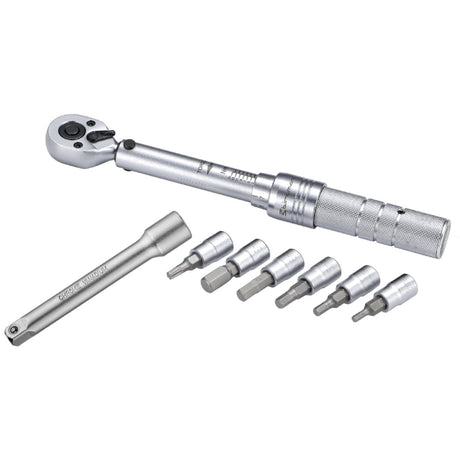
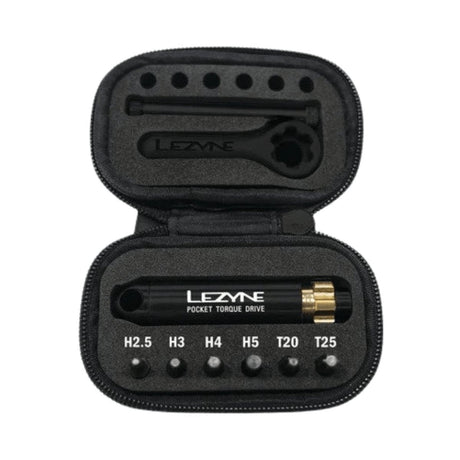
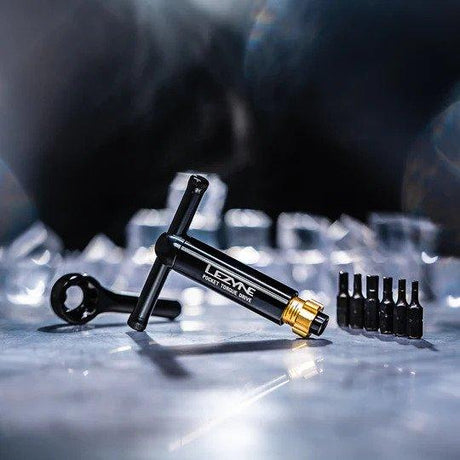
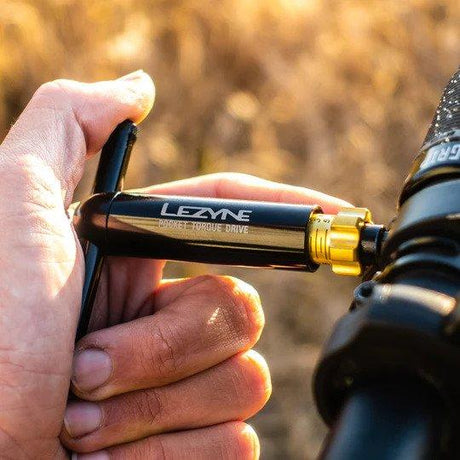
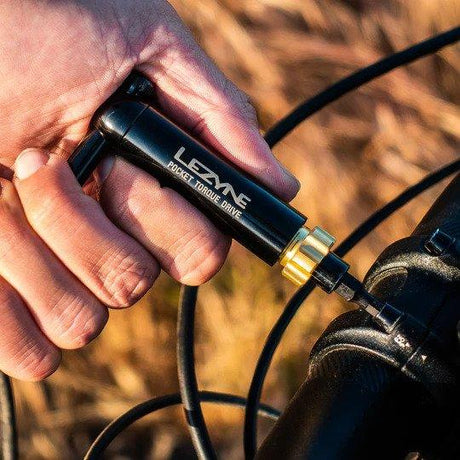
If any part of your bike is carbon, this is not optional. Carbon components fail by being crushed rather than by coming loose, and the difference between correct and too tight is not something your hand can judge. The Alligator torque wrench set at ₹9,890 covers the common bit sizes.
Our torque specifications reference lists the figures for each component.
Or buy a kit instead

Kits are worse value per tool and better value per decision. If you would rather not think about it, these are the ones worth buying.
| Kit | Price | Who it suits |
|---|---|---|
| IceToolz 801A Zipper Kit | ₹2,450 | A first kit, or one to keep in the car |
| IceToolz 82F4 Essence Kit | ₹9,290 | Covers most home jobs in one box |
| Pedros Burrito Kit | ₹22,900 | Serious home mechanic, roll-up format |
| Hozan S-10 Kit | ₹28,910 | Japanese quality, built to last decades |
| Pedros Apprentice Bench Kit | ₹63,150 | Genuinely a workshop, not a home kit |
The honest advice: the ₹2,450 zipper kit plus a proper floor pump and a chain wear indicator bought separately will serve most riders better than a ₹9,290 kit, because the money goes into the tools you use rather than the ones you do not.
The drivetrain tools

The second tier, and the point at which you stop paying someone to change a cassette. Total cost is around ₹4,000.
- Cassette lockring tool, IceToolz 09C2 with guide pin at ₹1,050. The guide pin version is worth the extra over the plain one because it keeps the tool square.
- Chain whip, IceToolz 53A2 at ₹990 or the Lezyne Classic Chain Rod at ₹1,975. You need this and the lockring tool together, since one holds the cassette while the other undoes it.
- Chain cleaner, Muc-Off X-3 at ₹3,000. Optional, but it turns a twenty minute job into a five minute one, which means it actually gets done.
- Cone wrenches, IceToolz 47X7 set at ₹3,890, if your wheels use cup and cone hubs.
Two small things worth adding at some point: a chain keeper at ₹2,950 holds the chain when you remove the front wheel to clean the drivetrain, and a dummy pedal at ₹790 protects the crank thread when the bike travels.
The repair stand question
A stand makes every job easier and no job possible. That is why it comes last rather than first, and why a lot of people never buy one.
What it genuinely changes is drivetrain work, because turning the pedals with the rear wheel off the ground is awkward otherwise, and any job where you need both hands. If you mostly adjust and inflate, you can lean the bike against a wall for years.
The Feedback Sports Sprint at ₹29,999 holds the bike by the fork rather than clamping the frame, which is the right approach for carbon. The Pro Mechanic at ₹34,999 is the traditional clamp design. The Birzman Feexstand at ₹13,900 doubles as bike storage, which suits a flat.
Do not clamp a carbon seatpost or a carbon frame tube. If your only stand is a clamp type, clamp an old alloy seatpost fitted for the purpose.
Tools not to buy
Some tools are cheap enough to tempt you and specialised enough that you will use them twice in a decade. These are the ones to leave with a shop.
- Headset press and cup remover. Fitting a headset badly damages the frame, and the tools cost more than several professional fittings.
- Facing and reaming tools. The crown race cutter and similar are frame-shop equipment. Getting it wrong is expensive and permanent.
- Wheel truing gauges. Truing a wheel is a skill rather than a tool, and a badly tensioned wheel fails in a way you do not want to discover at speed.
- Internal routing kits. Worth it if you build bikes regularly, otherwise a job to hand over.
- Bottom bracket press tools. Press-fit bottom brackets in particular reward doing once, correctly, with the right tool.
We do stock all of these, and if you genuinely want them they are there. But for most home mechanics the money is better spent on the first five.
Prices are indicative and move with exchange rates and import duty.
FAQs
Do I really need a torque wrench, or is hand-tight enough?
If every part you touch is aluminium or steel, careful hand-tightening will usually get you close enough. If anything is carbon, a handlebar, a seatpost, a stem or a frame, then no, it is not enough, and this is the single most common way expensive components get destroyed at home. Carbon fails by crushing rather than by loosening, so the damage happens silently at the moment you overtighten and shows up later as a crack. Stem and seatpost clamp bolts are typically in the five to seven newton metre range, which is far less force than most people apply instinctively.
Are cheap hex keys really a problem?
Yes, and it is the one place we would push you to spend more. Soft steel keys deform slightly under load, which rounds the inside of the bolt head, and once a bolt is rounded you are into drilling it out or taking the bike to a shop with an extractor. The damage is cumulative and invisible, so the failure comes without warning on a bolt you have undone twenty times before. Good keys also fit more precisely, which means less slip and fewer knuckles on the chainring.
How do I know when my chain is worn, and does it actually matter?
Use a wear indicator monthly. For 11 and 12-speed drivetrains replace the chain at 0.5 per cent elongation, and for older and wider drivetrains 0.75 per cent is the usual threshold. It matters because a worn chain reshapes the cassette teeth as it stretches, so a chain replaced in time costs you a chain, while one left too long costs you a chain and a cassette together, which on a modern groupset is a large difference. A new chain on a worn cassette also skips under load, which is unpleasant and sometimes dangerous.
Can I service a bike properly without a repair stand?
For most jobs, yes. Turn the bike upside down on a mat for anything involving the wheels, and lean it against a wall for adjustments. Drivetrain work is the awkward one, because you need the rear wheel spinning freely while you watch the derailleur, and the usual workaround is to hang the saddle over the back of a chair with something soft under it. A stand is a comfort purchase rather than a capability one, which is why it belongs at the end of the list rather than the start.
What should I carry on the bike, as opposed to keeping at home?
Completely different lists, and people often confuse them. On the bike you want a multitool with the common hex sizes, a spare tube, tyre levers, a hand pump or CO2, and a quick link that matches your chain. At home you want the tools in this article, which are bigger, heavier and better at their jobs. The one overlap worth having twice is a quick link, because it weighs nothing and it is the difference between riding home and walking.
Narrowing it down
Not sure what your bike actually needs? Ask TBA Guide with the make and groupset, and we will tell you which tools fit it and which ones you can skip.