


IceToolz 12S4 Nipple Wrench for Deep Rims Blister Card
Regular price ₹850Unit price
IceToolz 12T4 Bladed Spoke Catcher
Regular price ₹390Unit price

IceToolz E312 Wheel Centering Gauge
Regular price ₹2,990Unit price
IceToolz 1206 6-Groove Spoke Wrench
Regular price ₹350Unit price


IceToolz 12D6 Spoke Tool For 3.6mm (Square) Nipples
Regular price ₹890Unit price
Cyclus Tools Thru Axle Adapter For Truing Stand - Up To 24mm Diameter - Pair
Regular price ₹5,500Unit price

Magene Exar Vonoa Spoke Holding Tool For Ultra Wheels
Regular price ₹1,295Unit price


IceToolz 08C5 14-15G 0.136" Spoke Wrench
Regular price ₹650Unit price
Unior 1692/4 Dropout Alignment Gauges
Regular price ₹6,675Unit price
Cyclus Tools Snap.In Remover | For Threaded Rings DT Swiss Hub 240 | SN.56-W
Regular price ₹5,500Unit price
Cyclus Tools Remover For Threaded Rings DT Swiss Hub 240 SW 19
Regular price ₹4,250Unit price

Cyclus Tools Spare Plastic Tips For Truing Stand (720085 and Article: 720081 - Pair)
Regular price ₹494Unit price

Cyclus Tools Rim Repair Tool, For Pushing Out Dents
Regular price ₹7,060Unit price
Cyclus Tools Axle Support C Long Plastic Adapter - 1 PC
Regular price ₹1,280Unit price

Cyclus Tools Axle Vice Springloaded, 9mm and 10mm
Regular price ₹4,850Unit price
Cyclus Tools D Long Slotted Axle Support Plastic Adapter - 1 PC
Regular price ₹1,280Unit price
Cyclus Tools Axle Support F Plastic Adapter - 1 PC
Regular price ₹10,900Unit price


Hozan C-335 Wheel Alignment Gauge
Regular price ₹17,995Unit price

IceToolz E313 Wheel Centering Gauge 0.1mm Meter
Regular price ₹10,790Unit price


 Regular price ₹14,490Unit price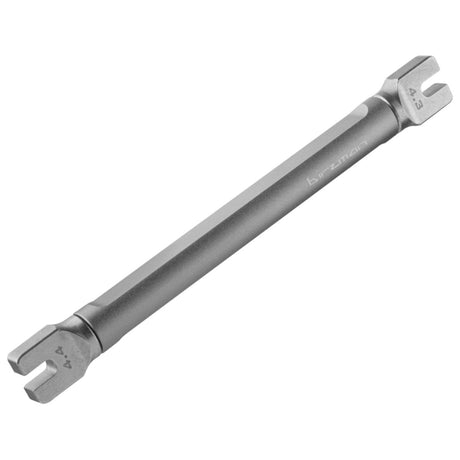
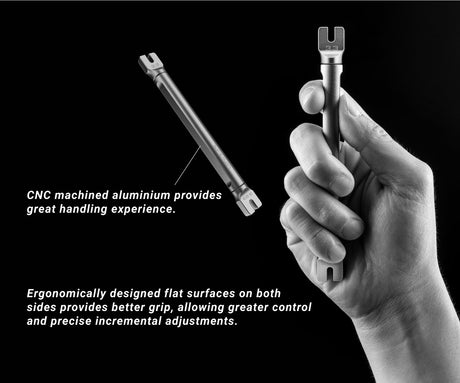
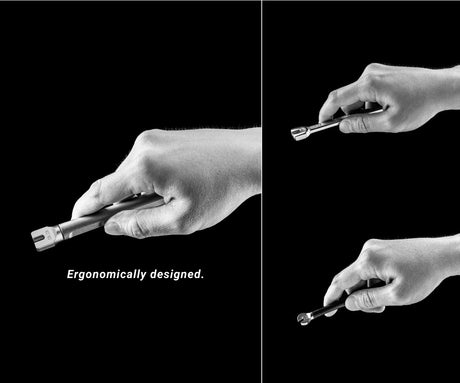
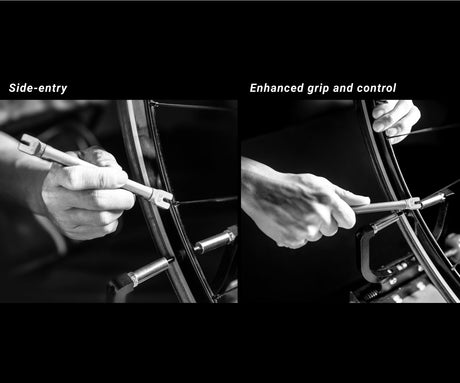
Birzman Double-Ended Spoke Wrench
Regular price ₹1,510Unit price

Birzman Spoke Wrench Gold 3.96
Regular price ₹595Unit price


Frequently Asked Questions
What size spoke wrench do I need?
What size spoke wrench do I need?
Spoke nipple sizes vary by manufacturer, and using an oversized wrench rounds the nipple. A multi-size wrench covering several common sizes is the safe first purchase. For a specific gauge, a dedicated single-size wrench gives a tighter fit and more control. Check your nipple size before ordering, as a loose fit causes damage quickly.
Can I true a wheel without a truing stand?
Can I true a wheel without a truing stand?
Yes, using the brake pads or the frame as a reference point, which works well enough for correcting a small lateral wobble. What you cannot judge in the frame is dish, meaning whether the rim is centred between the hub locknuts. A wheel centring gauge solves that and is more useful than a stand for occasional work.
Why do bladed spokes need a special tool?
Why do bladed spokes need a special tool?
A bladed spoke will twist along its length when you turn the nipple, storing tension that later releases and knocks the wheel out of true or breaks the spoke. A bladed spoke holder clamps the flat section so it cannot rotate. It is an inexpensive tool that prevents an expensive wheel rebuild.
How do I true a wheel with deep-section rims?
How do I true a wheel with deep-section rims?
Deep rims hide the nipple inside the rim well, so a standard spoke wrench cannot reach it. A long nipple wrench or nipple driver is designed to reach through, and some deep wheels instead require adjustment at the rim bed with the tyre removed. Check how your specific wheel is built before starting, as the method differs between manufacturers.
What is wheel dish and why does it matter?
What is wheel dish and why does it matter?
Dish is whether the rim is centred between the hub's locknuts rather than sitting off to one side. A wheel can be perfectly round and true laterally yet badly dished, which makes the bike track oddly and puts the rim off-centre in the frame. A wheel centring gauge measures it directly; you cannot judge it by eye in the frame.